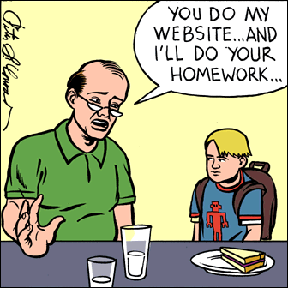
The majority of children that are learning in our classrooms today have been born into a world where using a smartphone, tablet, computer or other digital device is normal. They are learning to use these devices pretty much from the moment they are born and see them as part and parcel of the world that we live in. Rapidly, because of early interactions with this kind of technology, they become proficient in using these tools as naturally as they begin to speak their mother tongue. Using some kind of ‘smart’ device becomes as much part of everyday life to these ‘digital natives‘ as driving a car to work or even just simply pressing a switch to create artificial light may have been for their parents. Bauer (2014) explains that technology, especially referring to devices like smartphones, and ubiquitous access to the Internet ‘have been interwoven into the fabric of our lives (p4)’ . The incorporation of this sort of technology into everyday living can seem like a sort of magic to those who were not born into this digital age, and yet it is that generation that will mostly be the classroom teachers and leaders today. Is it possible then for these ‘digital immigrants’ to successfully integrate the use of technology in their teaching and provide quality learning experiences that are still relevant and useful to digital natives? How much can digital natives learn from digital immigrants?
Thomas Friedman (2006) talks about technology flattening the world and this ‘flattening’ process started with the greater ease of travel, particularly motor vehicles and airplanes, in the early part of the twentieth century. Not only have people been able to see more of the world, in many cases, and perhaps increasingly, we are seeing a rise of immigrants to different parts of the world. In order to properly live in a new country and fit in, these immigrants need to adapt to new cultures, traditions and languages. They may have to adjust to new tastes and relate to different understandings of the world possibly by learning new languages and ways of doing things. The advice for expats from ‘Internations ‘in order to get the most of overseas living is to ‘immerse yourself in the new culture’ and ‘break out of your comfortable cocoon’. The same might be applied in relation to technology for digital immigrants too.
In the case of music education, it is vital to consider how technology can be incorporated into classroom learning effectively. The history of music education has been littered with changing technologies, and due to the creative and changing nature of the subject, this is likely to continue forever. We perhaps need to redefine what we consider to be called music and what constitutes a musical activity that effectively takes this changing nature into consideration (Brown 2015). It’s easy perhaps to see technology as a replacement for something else, and we really have to reconsider how a new piece of technology will be used. Is Sibelius notation software just a replacement for manuscript paper and pencil for example? A digital native will often see alternative uses for technology that a digital immigrant hasn’t considered. It is perhaps here that we should trust today’s children and give them ownership of the learning space (Heppell 2014). At the same time we need to think about the link between old and new technologies (Brown 2015). Using a pencil to compose at the piano, alongside aural training, is still an important factor of music learning. Over reliance on using Sibelius, for example, does not create better compositions on its own. However, an understanding of what Sibelius does, and how it may assist the learning process, as well as trusting a digital native to be creative with the technology that they understand may help to develop skills.
Digital immigrants are forced to learn new technologies in order to be effective practitioners and we must make the most of these opportunities. Digital natives need to be trusted to create their own learning environments with technology and they need to see the relevance of what they learn being brought into the real world. Technology has given us real world experiences through connectivity, like never before and this needs to be embraced. Blogging and You Tubing, for example, can be very much part of the classroom experience. Being a digital immigrant means, needing to adapt and embrace the culture whilst also bringing our prior knowledge and experiences to the learning table.
Bauer, W. I. (2014). Music Learning Today: Digital Pedagogy for Creating, Performing, and Responding to Music.New York: Oxford University Press, USA
Brown, A. (2015). Music Technology and Education: Amplifying Musicality. New York: Routledge.
Friedman, T.L. (2006). The world is flat. A brief history of the twenty-first century (Updated and expanded edition). New York: Farrar, Straus and Giroux
Heppell, S. (2014). EduTECH talk by Stephen Heppell on teaching technologies on the cusp. [Website.] Retrieved from https://www.youtube.com/watch?v=teWsnG5G0fA accessed 16th Dec 2016
Internations (n.a). https://www.internations.org/magazine/living-in-a-foreign-country-how-to-adapt-15281 accessed 17th December 2017
Price, D. (2014). David Price on The Open Learning Revolution | Amplify 2013. [Website.] Retrieved from https://www.youtube.com/watch?v=3fGv3_kaGa8 24th Jan, 2016.
 Staples Music
Leave a comment