A music classroom needs to be a place of creative energy that is motivating its students to enjoy what they are doing. The lessons should be allowing them to experiment with ideas in different ways and find which of these ways will suit their creativity. This creativity should come from a range of; making entirely new compositions, re-arranging or remixing existing works and being involved in the performance process. Along the way they should be looking at artists or composers that have worked within the same genre to see how they worked, as well as for possible inspiration and modelling. The classroom should very much be about ‘doing’ and being involved in the whole process rather than any passive form of learning. The activities in the classroom need to be seen as relevant to the ‘real world’ as it is today. Therefore the classroom must also embrace technologies that are relevant and useful to both the students and teacher.
Music is essentially a practical subject and although there is a lot of theory behind the understanding of music, this should not get in the way of the subject’s primary purpose which is as a creative subject. A child usually learns to draw early on in life, he or she creates pictures without understanding the theories behind art (such as perspective drawing, understanding light and shading etc) and this should also be the case with music, except there often seems to be a perception that you have to have piano lessons (or whatever) before you can even touch the instrument. Louis Armstrong learnt his art through very successful trumpet playing this way. So the first priority should be to give all children a chance to play. This play can hopefully guide an interest and the theory can come in at a time when the child is ready for it. Methods such as Orff Schulwerk certainly give children the opportunity to play whilst incorporating the understanding as part of that play, and are especially suitable for Early Years to Primary school level children.
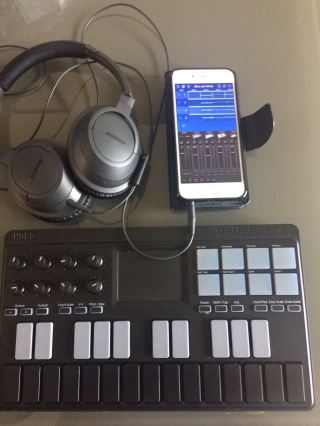
The idea of what constitutes an instrument can also be challenged though. Technology has made instruments available that are a fraction of the cost (and size in some cases) of their acoustic counterparts, electronic keyboards (or digital pianos) as just one example. The power of the computer chip has meant that even a cell phone can create the variety of sounds that are found in one of these digital instruments, with a connection to a MIDI controller or even by just interacting with the touch screen, (which are also becoming pressure sensitive) the cell phone can be turned into a musical instrument. For some students, the use of their cell phone to explore playing and creating music, maybe an ideal vehicle for motivation.
The transition into adulthood for teenagers means that they need to connect with the world as it is ‘today’. New innovations are going to be inspiring for them, as this will be seen as ‘modern’ or as being ‘in-touch’ with the world. The competence level of our new digital natives also means that they are already able to understand and use the technologies. With careful guidance teachers should be able to help students in an appropriate use of the technology that promotes learning and creating. This does mean that teachers need to learn these technologies too and be prepared to be taught by their students.
In my own work, I would like to see an increased use of the way technology is used. I am using a Musical Futures style approach where children select from a variety of instruments and perform together and we also sing regularly as part of the programme. I find that, through doing, children get a better understanding of how the music is put together. I have used DAWs like Garageband, but would like to take this further. I have also started using a ‘Jam Hub’, which has meant a group of students can rehearse just like a band together through headphones, and I am interested in developing this further by perhaps making creation and performing ‘stations’ like we saw in Northern Beaches Christian School. I am also looking at other ways for students to submit their work, and from this course I would like to explore the ideas of creating blogs, podcasts and possibly You Tube postings.
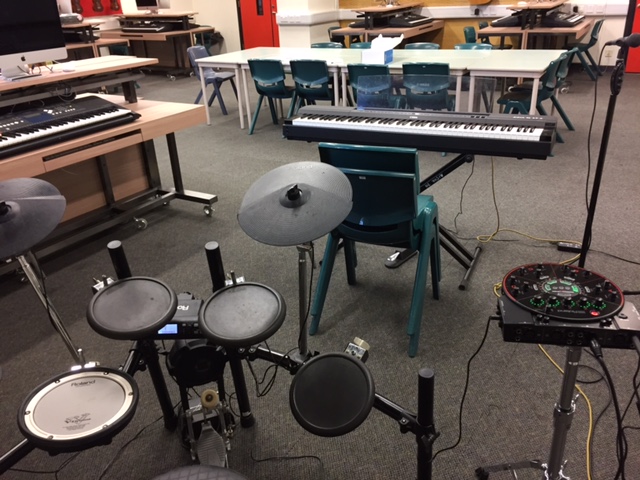
One of the projects I have wanted to re-develop was my ‘Songwriting’ course in Year 8. Whilst I think it has worked in the past, I believe it could be improved by incorporating more use of DAWs for either editing final work or driving the creative thought in the first instance. I need to give students a little more freedom in the way that they work and be prepared for them to suggest how they might achieve a similar outcome in a different way. I do not want the children sat at their computers all the time though and I feel that practical activities (like a ‘chair drumming’ exercise I do as well as singing) still need to be very much part of the lessons.
As a teacher, I feel it is very important for me to keep in touch with how technology is developing. I need to investigate what is relevant and what is not as well as what would be practical in the classroom. Through being flexible I need to guide students to success whilst acknowledging that they may not get there the same way that I would.

 Staples Music