This is my first ever blog, so I want to experiment to find out what I do. This has been created as I am following the MOOC from The University of Sydney on ‘The Place of Music in 21st Century Education’.
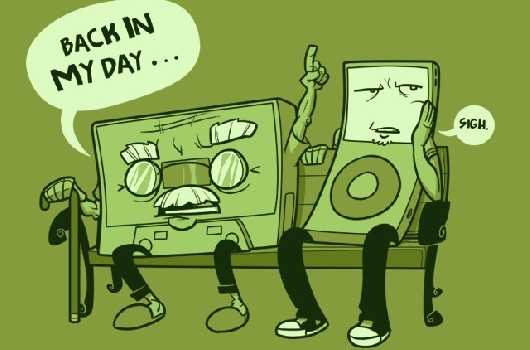
Technology is ever apparent in my daily life and I have seen just how quickly it evolves. From remembering taping my walkman to my bike for my rides home from school, to buying my first CD player when I left home for college. I had catalogued all my CD’s on an excel spreadsheet, filtering according to instrument, composer and era etc. After that it was the gift of my ipod classic, which saved me hauling my CD’s around the world, and the creation of playlists according to album and then to the discovery of Spotify and Apple Music that gives me access to so much music and the ability to create playlists for every possible reason and the chance to discover new music unlike ever before.
When I think how my own classroom has changed too, its mostly because of technology advances and I feel that I need to get more out of what is already happening around me and just by doing a course such as this online, is all part of that process. Hopefully this blog will teach me a thing or two and hopefully I also have something worth sharing with others.
A music classroom needs to be a place of creative energy that is motivating its students to enjoy what they are doing. The lessons should be allowing them to experiment with ideas in different ways and find which of these ways will suit their creativity. This creativity should come from a range of; making entirely new compositions, re-arranging or remixing existing works and being involved in the performance process. Along the way they should be looking at artists or composers that have worked within the same genre to see how they worked, as well as for possible inspiration and modelling. The classroom should very much be about ‘doing’ and being involved in the whole process rather than any passive form of learning. The activities in the classroom need to be seen as relevant to the ‘real world’ as it is today. Therefore the classroom must also embrace technologies that are relevant and useful to both the students and teacher.
Music is essentially a practical subject and although there is a lot of theory behind the understanding of music, this should not get in the way of the subject’s primary purpose which is as a creative subject. A child usually learns to draw early on in life, he or she creates pictures without understanding the theories behind art (such as perspective drawing, understanding light and shading etc) and this should also be the case with music, except there often seems to be a perception that you have to have piano lessons (or whatever) before you can even touch the instrument. Louis Armstrong learnt his art through very successful trumpet playing this way. So the first priority should be to give all children a chance to play. This play can hopefully guide an interest and the theory can come in at a time when the child is ready for it. Methods such as Orff Schulwerk certainly give children the opportunity to play whilst incorporating the understanding as part of that play, and are especially suitable for Early Years to Primary school level children.
The idea of what constitutes an instrument can also be challenged though. Technology has made instruments available that are a fraction of the cost (and size in some cases) of their acoustic counterparts, electronic keyboards (or digital pianos) as just one example. The power of the computer chip has meant that even a cell phone can create the variety of sounds that are found in one of these digital instruments, with a connection to a MIDI controller or even by just interacting with the touch screen, (which are also becoming pressure sensitive) the cell phone can be turned into a musical instrument. For some students, the use of their cell phone to explore playing and creating music, maybe an ideal vehicle for motivation.
The transition into adulthood for teenagers means that they need to connect with the world as it is ‘today’. New innovations are going to be inspiring for them, as this will be seen as ‘modern’ or as being ‘in-touch’ with the world. The competence level of our new digital natives also means that they are already able to understand and use the technologies. With careful guidance teachers should be able to help students in an appropriate use of the technology that promotes learning and creating. This does mean that teachers need to learn these technologies too and be prepared to be taught by their students.
In my own work, I would like to see an increased use of the way technology is used. I am using a Musical Futures style approach where children select from a variety of instruments and perform together and we also sing regularly as part of the programme. I find that, through doing, children get a better understanding of how the music is put together. I have used DAWs like Garageband, but would like to take this further. I have also started using a ‘Jam Hub’, which has meant a group of students can rehearse just like a band together through headphones, and I am interested in developing this further by perhaps making creation and performing ‘stations’ like we saw in Northern Beaches Christian School. I am also looking at other ways for students to submit their work, and from this course I would like to explore the ideas of creating blogs, podcasts and possibly You Tube postings.
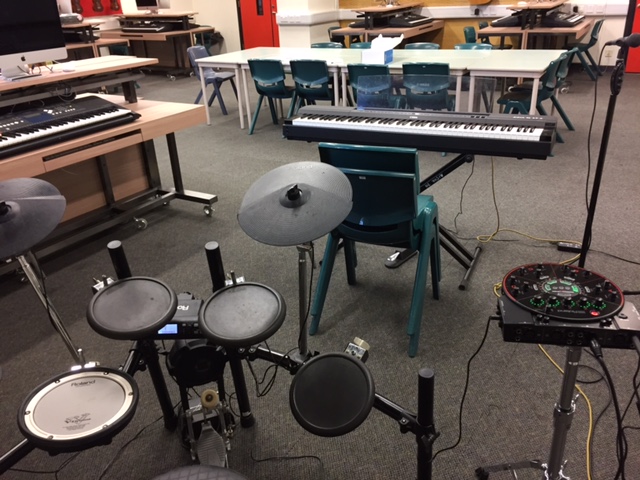
AISHK Music Classroom, with Roland HS-5 ‘Jam Hub”, Apple iMac with Garageband Software, MIDI keyboards etc
One of the projects I have wanted to re-develop was my ‘Songwriting’ course in Year 8. Whilst I think it has worked in the past, I believe it could be improved by incorporating more use of DAWs for either editing final work or driving the creative thought in the first instance. I need to give students a little more freedom in the way that they work and be prepared for them to suggest how they might achieve a similar outcome in a different way. I do not want the children sat at their computers all the time though and I feel that practical activities (like a ‘chair drumming’ exercise I do as well as singing) still need to be very much part of the lessons.
As a teacher, I feel it is very important for me to keep in touch with how technology is developing. I need to investigate what is relevant and what is not as well as what would be practical in the classroom. Through being flexible I need to guide students to success whilst acknowledging that they may not get there the same way that I would.
In this blog we were asked to respond to some questions as follows;
You were introduced to the DAW (or sequencer), the step sequencer, and a range of notation software. Do you feel you would like to explore any of these technologies further?
I am convinced that the DAW can be a very powerful tool for using in the classroom. They give an instant way to record music whether through live or step input. They give opportunities to manipulate sound and arrange and re-arrange the tracks that have been created to structure a song or musical creation. They also give access to new sounds and sounds that may otherwise be unavailable in the normal classroom setting.
I have been fascinated with technologies that are truly portable and have found the Korg Gadget app, a DAW, available for iOS devices an amazing resource with much potential, although sadly this is just available on one platform. I made my own tutorial for it which you can view by following this link.
Have you been persuaded that the DJ-producer does have an awful lot of sophisticated musical skills?
I always thought that the DJ producer did have a lot of skills, although I guess I never fully analysed what all these skills were. On looking at the Madeon performance in this course I was astonished with all the musical thought that was required to make such an effective performance. It gives great insight into the power of the potential use of both the laptop and the turntable as a musical instrument in itself.
Do you agree with David Price that learning has gone “OPEN”?
On reflection I believe that human beings have always been ‘Open’ learners. My grandmother would share her recipes (with those she liked) and she would have her work assessed (in many ways) through organisations like the Women’s Institute in baking contests etc. We like learning, and we seem to learn best from those that are close to us. Television brought us Open University courses and also the world of reality TV opened up. Open Learning has simply been made easier because of the internet and portable devices, but it is a very relevant way to how we live our lives today.
What were the best examples of OPEN learning that you found either in the course content, in your own searching, or the work of your peers?
You Tube could perhaps be the first “go to” place to find out the things that we want to know. Here a video of my son (unprompted by me) learning one of his favourite songs via a You Tube video.
This course, (The Place of Music in 21st Century Education from Coursera) is an excellent example of a more detailed form of open learning . To find the best examples though, needs some careful filtering, which takes time. This is an area where a teacher might be able to guide students too.
What does Project Based Learning (or the other BLs) have to offer Music Education? And what does Music Education have to offer Project Based Learning, andalllearning, in the 21st Century?
Project Based learning gives a real life goal for the students to achieve, it makes programmes realistic and relevant to students needs today. Students can spend more time drafting work, so assessing process becomes a more important tool for teachers, rather than just concentrating on outcomes. Project based learning can bring individual learning and group learning together and the teacher becomes part of the process of learning rather than the dictator of learning.
The very nature of music education is already project based and the excellent work that music teachers do in the classroom needs to be celebrated and set as a model example for education throughout all learning areas!
Short sample excerpt of using tech with traditional instrument. Performance of Piano Accordion “Blue and White” by J Kuoppamaki with accompaniment created on Roli ‘Noise’ app for iPhone
Hasn’t technology always been a part of what music is about? The development of western classical music has largely been due to advances in technology, whether this is through the creation of new instruments, like the clarinet in the 1700’s or as a result of the Industrial Revolution during the Romantic era bringing new technologies to improve musical instruments as well as advances in printing technology changing the way composers published and printed their music. Through studying western classical music, we are in some ways, looking at the way technology has impacted on the development of composition from Renaissance through to Modern times anyway. Perhaps then we really should be embracing new technology, as we encourage our performers and composers of the future.
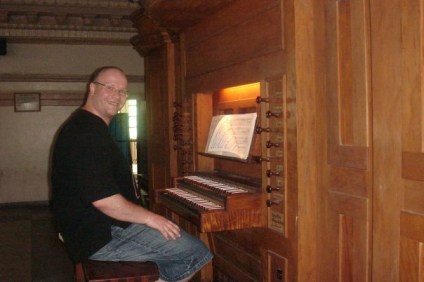
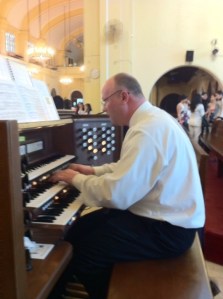
As a church organist I’ve had to continually adapt to the instruments that I have played. Sometimes, the consoles (and pipes) can be hundreds of years old with no playing aids to assist with registration changes or controlled crescendi using a swell box, or even mechanisms to lighten a heavy key action. Newer instruments can be completely digital (using sampled technology) and have programmable pistons to change the user settings. The organ in Notre-Dame cathedral, Paris, for example, is still the original instrument from 1730, using much original pipe work, but has also gained MIDI technology to help the player playback his own recordings and check registrations. In these cases, it seems that technology is here to help, so should we really be that worried about using it in the classroom?
Traditional Mechanical Action Pipe OrganModern Digital Organ
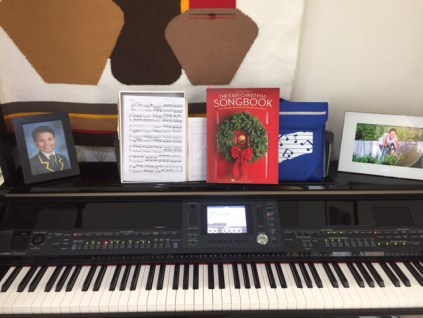
Brown (2014) states, that there is no reason why a musician cannot express themselves using digital technology. Digital instruments have been around for a long time now and are very well developed. Many people may learn on a Clavinova, or similar digital instrument at home. Naturally, they feel different to their acoustic counterparts, but convenience of size and the ability to plug in headphones, as well as price difference, is often very appealing. These types of instruments are not meant to replace traditional instruments; they serve a valuable function to aid learning music in the 21st century, through convenience of practice and perhaps exposing the learner to new sounds that they may not have experienced before.
Yamaha Clavinova, Digital Piano, also features other instrumental sound. The player can orchestrate and record their performances as though part of a band
If minds are transformed by changing technologies (Brown 2014), then we need to investigate these new sounds and technologies with an open mind. As part of a teacher’s planning and preparation, we must explore how we can link older and newer technologies by getting to know them well, and create a positive relationship with them. The use of smartphones for example, may be one of the technologies of the 21st century that can be used successfully in the classroom. It does, however, need to be managed, in the same way that a teacher would manage the student’s use of other equipment (like laptops, calculators, pens and pencils etc), in order to be useful, rather than a distraction.
The smartphone today, arguably, is the technological device at the centre of attention for 21st century living. The 2014 report from the Education Technology Action Group in the UK (ETAG) also promotes the fact that digital technology might empower teachers and learners. Prof. Stephen Heppell (2014), who leads this group suggests that it is “an essential contemporary skill set” that “offer[s] so much: data capture – children measuring light or sound levels to improve classrooms; [and] communications [with] slow-mo video for sports training [and] walking geometric shapes on to a playing field.” (Jeffreys 2015). It can be equally useful for music education too. With so many music apps available for smartphones, especially as many being free, it seems prudent to make use of these resources. This also follows the advice from David Price (2014), where technology is not only proving itself to be effective, “it is also bringing teachers and kids to the same level” and this therefore promotes good learning.
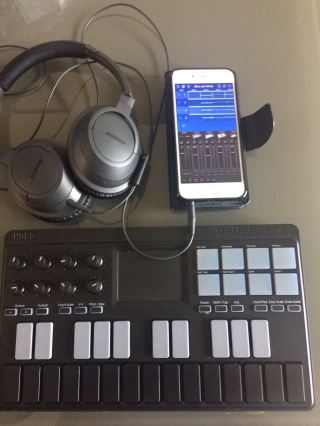
Digital Audio Workstations (DAW), for example, have been a software technology at the centre of music production for a number of years. Some companies have now released DAW apps for smartphones and tablets; again, many are free and thus easily available to today’s youth. It may also be seen as a relevant way to create music to our students today as this is exactly how a lot of the music that they listen to is also created and as Lucy Green (2002) has already commented; ‘teachers can learn a lot from the way popular musicians work’.
Korg Nano Key Studio, with iphone and Korg Gadge app. Possible typical equipment for the bedroom music producer
Performing and creating the music that students are familiar with, using technologies that are already part of the armoury of today’s digital natives seems like a good way forward for music teaching in the 21st century. From here, links still need to be made with music theory and aural training, as well as technologies from previous ages. Teachers and students need to evaluate which technologies and which traditions are appropriate for the tasks they are engaged with; they need to relate to real life experiences and be prepared to be open-minded. Tradition and technology need to exist and complement each other so that the skills acquired today can better prepare students for tomorrow’s needs whilst still preserving tried and tested techniques from previous generations.
What do we understand as the differences between noise and sound? We often use the word noise in a derogatory fashion to mean something that we find unpleasant or unwanted, but the circumstances seem to change when something is just a sound and when it becomes noise. For example, when we hear a large group of people having conversations with each other, the overview of the whole room is probably just noise but yet, to each of those individuals they are involved in a personal and valuable conversation.
What do we then make of John Cage’s own 4″33 with the ‘noises’ that are supposed to happen during the performance where these are considered to be part and parcel of that performance – have these noises now become sound because they are within the framework of a piece of music or is it exactly as Cage says; that he is using noise to make music?
Can any or any part of a piece of music be considered noise rather than a combination of sounds? Do we manipulate noise to become a sound that is tolerable to be called music?
The majority of children that are learning in our classrooms today have been born into a world where using a smartphone, tablet, computer or other digital device is normal. They are learning to use these devices pretty much from the moment they are born and see them as part and parcel of the world that we live in. Rapidly, because of early interactions with this kind of technology, they become proficient in using these tools as naturally as they begin to speak their mother tongue. Using some kind of ‘smart’ device becomes as much part of everyday life to these ‘digital natives‘ as driving a car to work or even just simply pressing a switch to create artificial light may have been for their parents. Bauer (2014) explains that technology, especially referring to devices like smartphones, and ubiquitous access to the Internet ‘have been interwoven into the fabric of our lives (p4)’ . The incorporation of this sort of technology into everyday living can seem like a sort of magic to those who were not born into this digital age, and yet it is that generation that will mostly be the classroom teachers and leaders today. Is it possible then for these ‘digital immigrants’ to successfully integrate the use of technology in their teaching and provide quality learning experiences that are still relevant and useful to digital natives? How much can digital natives learn from digital immigrants?
Thomas Friedman (2006) talks about technology flattening the world and this ‘flattening’ process started with the greater ease of travel, particularly motor vehicles and airplanes, in the early part of the twentieth century. Not only have people been able to see more of the world, in many cases, and perhaps increasingly, we are seeing a rise of immigrants to different parts of the world. In order to properly live in a new country and fit in, these immigrants need to adapt to new cultures, traditions and languages. They may have to adjust to new tastes and relate to different understandings of the world possibly by learning new languages and ways of doing things. The advice for expats from ‘Internations ‘in order to get the most of overseas living is to ‘immerse yourself in the new culture’ and ‘break out of your comfortable cocoon’. The same might be applied in relation to technology for digital immigrants too.
In the case of music education, it is vital to consider how technology can be incorporated into classroom learning effectively. The history of music education has been littered with changing technologies, and due to the creative and changing nature of the subject, this is likely to continue forever. We perhaps need to redefine what we consider to be called music and what constitutes a musical activity that effectively takes this changing nature into consideration (Brown 2015). It’s easy perhaps to see technology as a replacement for something else, and we really have to reconsider how a new piece of technology will be used. Is Sibelius notation software just a replacement for manuscript paper and pencil for example? A digital native will often see alternative uses for technology that a digital immigrant hasn’t considered. It is perhaps here that we should trust today’s children and give them ownership of the learning space (Heppell 2014). At the same time we need to think about the link between old and new technologies (Brown 2015). Using a pencil to compose at the piano, alongside aural training, is still an important factor of music learning. Over reliance on using Sibelius, for example, does not create better compositions on its own. However, an understanding of what Sibelius does, and how it may assist the learning process, as well as trusting a digital native to be creative with the technology that they understand may help to develop skills.
Digital immigrants are forced to learn new technologies in order to be effective practitioners and we must make the most of these opportunities. Digital natives need to be trusted to create their own learning environments with technology and they need to see the relevance of what they learn being brought into the real world. Technology has given us real world experiences through connectivity, like never before and this needs to be embraced. Blogging and You Tubing, for example, can be very much part of the classroom experience. Being a digital immigrant means, needing to adapt and embrace the culture whilst also bringing our prior knowledge and experiences to the learning table.
Bauer, W. I. (2014). Music Learning Today: Digital Pedagogy for Creating, Performing, and Responding to Music.New York: Oxford University Press, USA
Brown, A. (2015).Music Technology and Education: Amplifying Musicality. New York: Routledge.
Friedman, T.L. (2006). The world is flat. A brief history of the twenty-first century (Updated and expanded edition). New York: Farrar, Straus and Giroux
Heppell, S. (2014). EduTECH talk by Stephen Heppell on teaching technologies on the cusp. [Website.] Retrieved fromhttps://www.youtube.com/watch?v=teWsnG5G0fA accessed 16th Dec 2016
One of the problems with teaching children the music that is considered “their own culture” is determining exactly what that culture is, especially by the time they get to high school. There often seems to be a perception by teachers that what seems popular in the charts or on the radio will automatically be popular in the classroom. This is not necessarily the case, as already, children may have been exposed to a range of styles from friends, parents or media. Some may have developed specific taste preferences, whilst others may have not had the same opportunity. If you are then to teach children the music that reflects their culture, where do you begin?
David Price (2014), as well as many others, including Richard Gill (course video 8 “counterpoint”), have already said that there is not only one solution to teaching and learning. There will be as many different musical tastes in the same room as there are learning preferences; it is not a case of one size fits all. Richard Gill certainly advocated teaching an extremely wide range of music in primary schools through singing, and this should have potentially great results in preparing for high school, assuming the same children have been brought through to high school from primary school. But in so many cases, our schools have a more transient population, especially in an international school setting. If all of our children haven’t been brought through the same system, we need to think how to best cater for them in our high school classrooms.
The answer still seems to lie with guiding students to learn music through the music they already love. Music, for the most part, forms some kind of identity for a teen (King 2004) and so it makes sense to start with music that they are already familiar with (Campbell, Connell and Beegle 2007), but we, as educators also need to connect with and understand this music (Hein 2013), as well as see its value through student’s perspectives. Lucy Green (2011 ) advocates students choosing their own music and learning by ear with friends in much the same way as popular musicians learn, and this is certainly one of the ways of the Musical Futures approach that seems so successful. At the same time, I also support Richard Gill in the notion that students are at school to learn new things and therefore they also need exposure to music that will challenge and extend their learning.
References
Beegle, A., Campbell, P., & Connell, C. (2007). Adolescents’ expressed meanings of music in and out of school. Journal of Research in Music Education, 55(3), 220-236. Doi 10.1177/002242940705500304
Green L (2011), What can teachers learn from popular musicians? | UCL Institute of Education: [website] retrieved from www.youtube.com/watch?v=4r8zoHT4ExY 21st December 2016
Hein, E. (2013). Designing the drum loop: A constructivist iOS rhythm tutorial system for beginners. (Master’s thesis, New York University, NY). Retrieved from http://www.ethanhein.com/wp/my-nyu-masters-thesis/
 Staples Music