Short sample excerpt of using tech with traditional instrument. Performance of Piano Accordion “Blue and White” by J Kuoppamaki with accompaniment created on Roli ‘Noise’ app for iPhone
Hasn’t technology always been a part of what music is about? The development of western classical music has largely been due to advances in technology, whether this is through the creation of new instruments, like the clarinet in the 1700’s or as a result of the Industrial Revolution during the Romantic era bringing new technologies to improve musical instruments as well as advances in printing technology changing the way composers published and printed their music. Through studying western classical music, we are in some ways, looking at the way technology has impacted on the development of composition from Renaissance through to Modern times anyway. Perhaps then we really should be embracing new technology, as we encourage our performers and composers of the future.
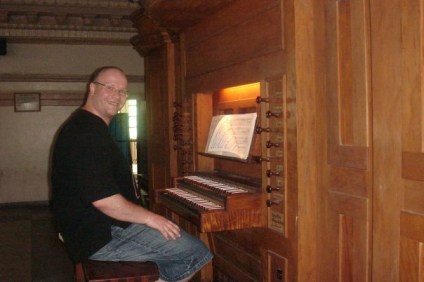
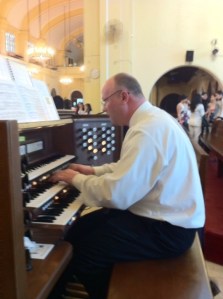
As a church organist I’ve had to continually adapt to the instruments that I have played. Sometimes, the consoles (and pipes) can be hundreds of years old with no playing aids to assist with registration changes or controlled crescendi using a swell box, or even mechanisms to lighten a heavy key action. Newer instruments can be completely digital (using sampled technology) and have programmable pistons to change the user settings. The organ in Notre-Dame cathedral, Paris, for example, is still the original instrument from 1730, using much original pipe work, but has also gained MIDI technology to help the player playback his own recordings and check registrations. In these cases, it seems that technology is here to help, so should we really be that worried about using it in the classroom?
Brown (2014) states, that there is no reason why a musician cannot express themselves using digital technology. Digital instruments have been around for a long time now and are very well developed. Many people may learn on a Clavinova, or similar digital instrument at home. Naturally, they feel different to their acoustic counterparts, but convenience of size and the ability to plug in headphones, as well as price difference, is often very appealing. These types of instruments are not meant to replace traditional instruments; they serve a valuable function to aid learning music in the 21st century, through convenience of practice and perhaps exposing the learner to new sounds that they may not have experienced before.
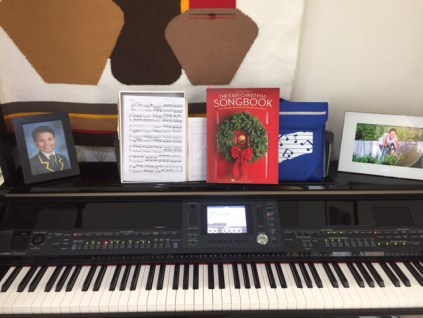
If minds are transformed by changing technologies (Brown 2014), then we need to investigate these new sounds and technologies with an open mind. As part of a teacher’s planning and preparation, we must explore how we can link older and newer technologies by getting to know them well, and create a positive relationship with them. The use of smartphones for example, may be one of the technologies of the 21st century that can be used successfully in the classroom. It does, however, need to be managed, in the same way that a teacher would manage the student’s use of other equipment (like laptops, calculators, pens and pencils etc), in order to be useful, rather than a distraction.
The smartphone today, arguably, is the technological device at the centre of attention for 21st century living. The 2014 report from the Education Technology Action Group in the UK (ETAG) also promotes the fact that digital technology might empower teachers and learners. Prof. Stephen Heppell (2014), who leads this group suggests that it is “an essential contemporary skill set” that “offer[s] so much: data capture – children measuring light or sound levels to improve classrooms; [and] communications [with] slow-mo video for sports training [and] walking geometric shapes on to a playing field.” (Jeffreys 2015). It can be equally useful for music education too. With so many music apps available for smartphones, especially as many being free, it seems prudent to make use of these resources. This also follows the advice from David Price (2014), where technology is not only proving itself to be effective, “it is also bringing teachers and kids to the same level” and this therefore promotes good learning.
Digital Audio Workstations (DAW), for example, have been a software technology at the centre of music production for a number of years. Some companies have now released DAW apps for smartphones and tablets; again, many are free and thus easily available to today’s youth. It may also be seen as a relevant way to create music to our students today as this is exactly how a lot of the music that they listen to is also created and as Lucy Green (2002) has already commented; ‘teachers can learn a lot from the way popular musicians work’.
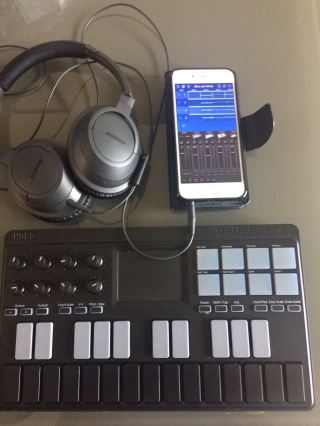
Performing and creating the music that students are familiar with, using technologies that are already part of the armoury of today’s digital natives seems like a good way forward for music teaching in the 21st century. From here, links still need to be made with music theory and aural training, as well as technologies from previous ages. Teachers and students need to evaluate which technologies and which traditions are appropriate for the tasks they are engaged with; they need to relate to real life experiences and be prepared to be open-minded. Tradition and technology need to exist and complement each other so that the skills acquired today can better prepare students for tomorrow’s needs whilst still preserving tried and tested techniques from previous generations.
References
Brown, A. (2015). Music Technology and Education: Amplifying Musicality. New York: Routledge. Sample chapter available from http://amzn.to/22RgYDM retrieved 30th December 2016
Green, L. (2002). How popular musicians learn: A way ahead for music education. Aldershot, England: Ashgate Publishing Ltd.
Heppell S (2014) Education Technology Action Group: our reflections [Website] http://etag.report/foreword/ retrieved 30th December 2014
Jeffreys B. (2015) Can a smartphone be a tool for learning?[Website] <http://www.bbc.com/news/education-34389063 retrieved 30th December 2014
Price, D. (2014). David Price on The Open Learning Revolution | Amplify 2013. [Website.] Retrieved from https://www.youtube.com/watch?v=3fGv3_kaGa8 24th Jan, 2016.
 Staples Music